
Call For A Consultation
949-388-3654
Army CID Investigation Defense Lawyer
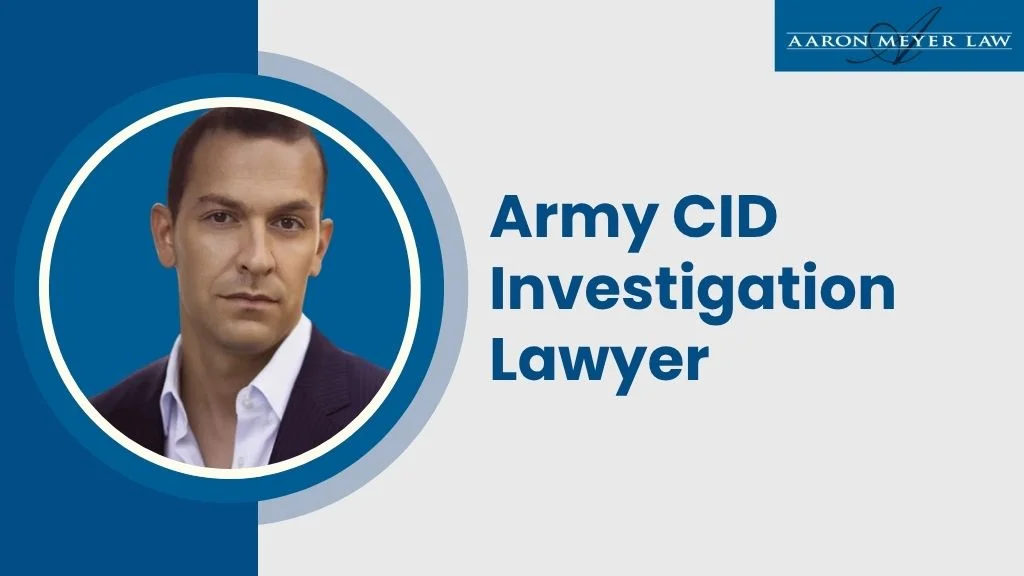
Skilled Army CID Investigation Defense Attorney
What to Know Before Your Next CID Interview
An Army CID investigation can put your military career at risk before you know whether you will ever face charges. The investigation can affect how your command views the allegations, what administrative action follows, and whether the government ultimately pursues a criminal case.
You do not need to wait for CID to finish its investigation before you take the situation seriously.
Aaron Meyer is a civilian Army CID investigation defense lawyer and former Marine Corps defense counsel. He has handled more than 75 documented military investigations and court-martial matters, using that experience to challenge the government’s case and protect service members throughout the investigative process.
The most important decisions are often made before a case reaches court. Getting legal advice early can help you understand where you stand and what options remain available.
Tell us where your CID investigation stands, and we can discuss what comes next.
| Avvo 9.1 Superb Rating | 5.0 Client Rating (19 Reviews) | Featured: Washington Times & Fox News | 75+ Case Outcomes |
What an Army CID Investigation Can Cost a Soldier Who Waits?
Army CID investigates serious offenses under military law, and an investigation can affect a soldier long before a court-martial begins. Some cases move quickly. Others remain open for months while promotions, assignments, and career decisions remain uncertain.
Common CID investigations involve:
- Assault and aggravated assault
- Sexual misconduct and sexual assault allegations
- Fraud and larceny
- Drug offenses
- Digital and computer-related offenses
An investigation does not have to result in charges to create consequences. CID may title a soldier as the subject of an investigation in the Army’s crime records system. That information can later affect background checks and security clearance reviews. A command flag can also interfere with a promotion or delay a permanent change of station while the investigation remains unresolved.
If CID recommends charges, the consequences can become more serious. Depending on the offense and the stage of the case, a soldier may face a GOMOR, non-judicial punishment, separation proceedings, or court-martial.
For serious offenses such as sexual assault or domestic violence, an independent Army Office of Special Trial Counsel determines whether the case should proceed rather than the chain of command.
A conviction can result in confinement, a punitive discharge, loss of rank and pay, and the loss of benefits tied to a military career.
That makes the first CID interview important. A soldier needs to understand their rights before answering questions, not after a statement has already become part of the investigative file.
The Kinds of Army CID Cases Our Firm Defends
Aaron Meyer defends soldiers throughout the CID process, from the first contact with an agent through administrative proceedings and court-martial. His practice includes:
- CID interviews and interrogations: advice before questioning and before any statement becomes part of the record
- Felony-level CID investigations: defense involving assault, sexual assault, fraud, larceny, drug, and digital offense allegations
- Command investigations: defense when a command investigation proceeds alongside a CID investigation
- GOMORs and adverse administrative actions: written rebuttals addressing allegations and seeking to prevent a reprimand from becoming a permanent part of a soldier’s record
- Security clearance actions: defense when CID findings put a security clearance at risk.
- Board of Inquiry and separation proceedings: representation when a CID investigation leads toward involuntary separation
- Non-judicial punishment hearings: advice about whether to accept punishment or demand trial by court-martial
- General and special court-martial defense: trial representation when charges are referred for court-martial
The right response depends on where the investigation stands and what CID has already done. Acting before the next stage can preserve options that may disappear later.
The First 24 Hours After Army CID Contacts a Soldier
The first day of a CID investigation presents decisions that can affect everything that follows. A few steps deserve immediate attention:
- Do not answer substantive questions without legal advice. Before making any statement, understand your rights and the consequences of waiving them
- Record what happened. Write down the agents’ names, badge numbers, questions asked, and anything else you remember while the details are fresh
- Do not discuss the investigation with other soldiers. Statements to other service members or communications through government systems may become evidence
- Speak with a civilian defense lawyer. A unit legal office serves the military in an official capacity and does not function as your personal defense counsel in a CID investigation
How Our Army CID Defense Attorney Builds a Case From Day One?
Aaron Meyer spent years serving as a Marine Corps defense counsel before entering private practice. That experience informs how he approaches military investigations from the beginning.
- He reviews prior statements. He examines anything a soldier has already told CID and works to prevent additional questioning from occurring without counsel
- He seeks the investigative file. As records become available, he reviews witness statements, forensic reports, and other evidence relevant to the allegations
- He addresses incomplete information. He communicates with the servicing legal office and command when the investigative record contains missing, inaccurate, or one-sided information
- He responds to administrative action. If a GOMOR or non-judicial punishment is proposed, he prepares a written response addressing the allegations and the potential impact on the soldier’s record
- He prepares for trial when necessary. If the case reaches a court-martial, he draws on documented military investigation and trial outcomes across the branches of service
Recent Outcomes From Military Investigation and Court-Martial Defense
Aaron Meyer’s practice includes military investigations and courts-martial involving the same types of CID, OSI, and NCIS matters service members may face. Reported results include:
| Outcome | Case Type |
|---|---|
| All Charges Dismissed With Prejudice | Air Force sexual assault investigation, Patrick Air Force Base, FL (2019) |
| Not Guilty of All Charges | Marine Corps Major, 7 charges, 3 accusers, Twentynine Palms, CA (2017) |
| All Charges Dismissed After Preliminary Hearing | Marine Corps Captain, sexual assault allegations, Quantico, VA (2019) |
| All Charges Dismissed After Preliminary Hearing | Air Force Master Sergeant, Misawa, Japan (2018) |
| Downgraded to Non-Judicial Punishment | Marine Corps Major, financial fraud allegations (2011) |
Prior results do not guarantee a similar outcome.
Where Our Army CID Investigation Defense Reaches
Army CID investigations can involve soldiers stationed anywhere in the United States or overseas. Aaron Meyer has represented service members at Fort Bragg, Fort Campbell, Fort Hood, Fort Bliss, Fort Irwin, Fort Carson, and Fort Huachuca, including soldiers who were deployed overseas when an investigation followed them back to their home station.
CID agents coordinate with military police, the servicing legal office, and command as an investigation develops. Understanding how those parts of the military justice system interact can matter when challenging an investigative finding or responding before command takes action.
The defense does not depend on where the investigation began. Soldiers can retain our firm whether CID opened the case at a stateside installation or the investigation followed a unit home from deployment.
The Two Rules of Military Law That Matter Most in a CID Investigation
Two provisions of the Uniform Code of Military Justice are especially important when CID begins questioning a soldier.
Article 31, 10 U.S.C. § 831, protects against compelled self-incrimination.
Before questioning a suspect, CID must advise the soldier of the nature of the accusation and the right not to make a statement. A statement given during an investigation may later become evidence at trial. Understanding those rights before answering questions can therefore have consequences well beyond the interview itself.
Article 32, 10 U.S.C. § 832, requires a preliminary hearing before a case can be referred to a general court-martial.
The hearing examines whether the case should move forward and can provide an opportunity to challenge weak or unsupported allegations before trial.
Answers for Soldiers Facing an Army CID Investigation
Do I need a lawyer before my next CID interview?
If CID has contacted you about an investigation, getting legal advice before answering questions can help you understand your rights and avoid making statements that could later be used against you. Waiting until after the interview may limit the ability to address problems with how the statement was obtained or what was said.
What happens after Army CID finishes its investigation?
CID generally sends its investigative report through the military justice process for further action. Depending on the offense and circumstances, that may lead to no further action, a reprimand, non-judicial punishment, administrative proceedings, or court-martial proceedings.
For certain serious offenses, including sexual assault, domestic violence, and murder, the Army Office of Special Trial Counsel has authority over the referral decision rather than the ordinary chain of command.
Will an Army CID investigation always lead to a court-martial?
No. An investigation can end without charges. The next step depends on the evidence, the offense under investigation, and the decisions made after CID completes its work.
Reviewing the investigative record early can help identify weaknesses or inconsistencies before command or prosecutorial authorities make important decisions.
What is titling, and does it show up on my record?
Titling means CID has identified a soldier as the subject of an investigation in the Army’s crime records system. It does not require a conviction. The information may later matter during background investigations or security clearance reviews.
Can a CID investigation affect my security clearance?
Yes. A CID investigation can create security clearance consequences separate from a potential court-martial. A clearance may face suspension or revocation action depending on the allegations and circumstances, and that process can proceed on its own timeline.
What is a GOMOR, and how do I respond to one?
A GOMOR, or General Officer Memorandum of Reprimand, is a written reprimand issued by a general officer. It may follow a CID or command investigation. A soldier generally has an opportunity to submit a written response, and the response can address the allegations and whether the reprimand should become part of the permanent record.
How is a command investigation different from a CID investigation?
A command investigation is directed by a commander to examine a particular incident or issue. CID investigates suspected serious crimes through its own investigative process. The two investigations can occur at the same time, and information developed in one may affect the other.
What happens at an Article 32 hearing?
An Article 32 hearing is the preliminary hearing required before a case can be referred to a general court-martial. It examines the evidence supporting the allegations and can provide an opportunity to challenge the case before trial.
Can I be investigated for something that happened off post?
Yes. Military investigators can investigate off-post conduct when it falls within their authority and involves a service member. Civilian authorities may also investigate the same conduct, creating separate military and civilian consequences.
How much does it cost to hire a civilian lawyer for a CID investigation?
The cost depends on the stage of the investigation and the representation required. Legal assistance may range from a strategy session for a soldier who has not been charged to representation throughout an investigation, administrative proceeding, or court-martial.
Do I have to talk to my chain of command about a CID investigation?
A soldier should be careful about discussing the substance of an open investigation with supervisors or other service members. Additional statements can become part of the investigative record.
Before discussing the allegations, a soldier should understand what is required and what protections may apply.
What if I already gave a statement to CID without a lawyer?
Giving a statement does not necessarily end the ability to challenge how the investigation was conducted. A defense lawyer can review the circumstances of the interview, the warnings provided, and the statement itself to determine whether there are grounds to challenge its use.
If your question about an Army CID investigation is not answered here, contact Aaron Meyer Law to discuss what the investigation has involved and what should happen next.
Talk to an Army CID Investigation Defense Lawyer Before Your Next Interview
An Army CID investigation can progress quickly, and early decisions can affect the options available later.
Aaron Meyer brings former Marine Corps defense counsel experience and more than 75 documented military investigation and court-martial outcomes to the defense of service members facing serious allegations.
His work has been covered by The Washington Times and Fox News, but the immediate issue is your investigation and what happens next.
If CID has contacted you, do not wait until charges are filed to understand your position. Tell Aaron Meyer where the investigation stands, what CID has asked, and what you have already been told. He can explain the next steps and help you decide how to proceed before your next interview.
Request A Free Consultation
Fields Marked With An “*” Are Required
"*" indicates required fields

4100 Newport Place
Suite 620
Newport Beach, CA 92660
Call Us Now
© Copyright 2026 Aaron Meyer Law • All rights reserved.

*Images are obtained under license from Canva and other third-party stock image providers, with attribution included where required.